
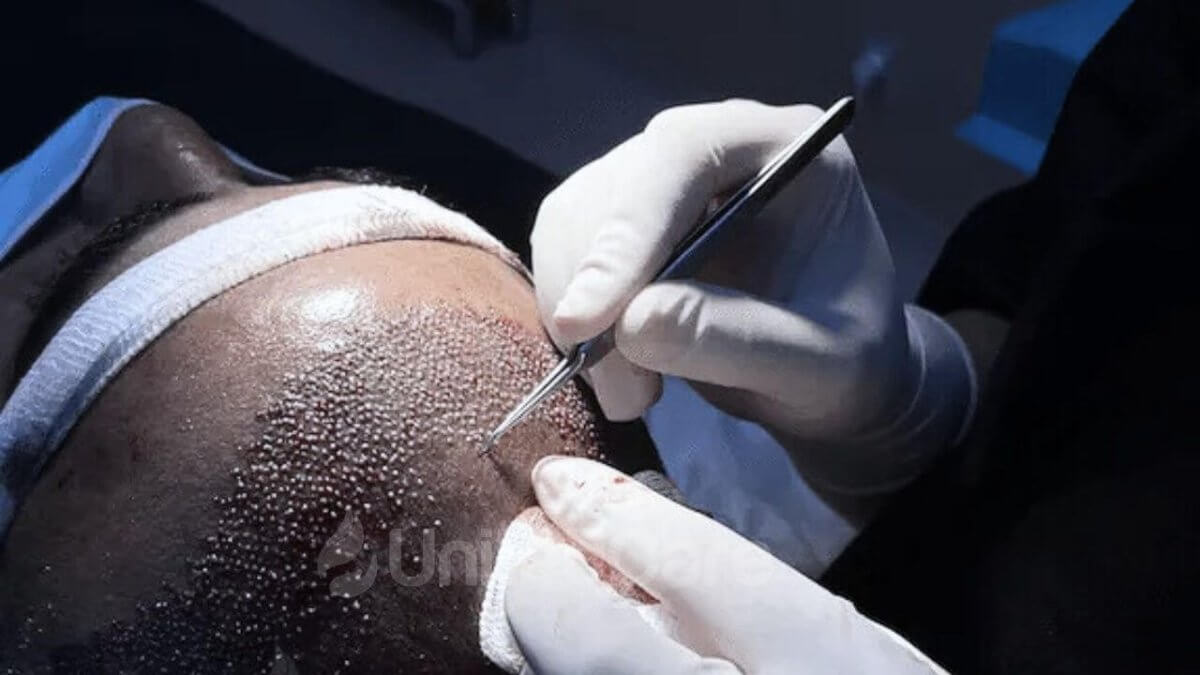
When I randomly surfed the internet about DHI vs FUE hair transplants, I came across so much incorrect information.
I thought, “Do they really publish this kind of content so casually on such a critical topic?”
So, I decided to write this article myself. Let’s go over DHI vs FUE together.
Table of Contents
What are the same for DHI vs FUE Hair Transplant?
Up until the last step, DHI and FUE are the same. I’ll focus on the most critical points in these stages and highlight the most common mistakes made by clinics:
- Planning:
- A 3-minute hairline design is a big no. At least an hour is required for professional planning.
- AI hair analysis is essential with close-up photos, to evaluate miniaturization, graft counts, etc.
- The head shape is never perfect, and hair directions vary by zone. Custom hair direction arrows/indicators should be drawn.
- Punch Incision and Extraction Stage:
- Punch size is really crucial. Big punch sizes cause scarring, small punches damage hairs/grafts.
- To determine punch size, the surgeon should test different punch sizes, like 0.8mm and 0.9mm, and find the optimal balance.
- Sometimes switching between sizes is also common practice.
- Graft Harvesting and Storage
- Extraction must be done carefully and slowly to avoid damaging hairs/grafts.
- Grafts should be stored in organ transplant solutions with PRP and other additives.
- Ringer’s Lactate (a graft preservation fluid) can cause graft loss. It is not an ideal environment for living cells outside the body.
- Cooling the grafts is a common mistake. Living cells maintain themselves through metabolism, and cooling disrupts this process.
- Graft Implantation (Stage at which DHI and FUE differs)
- 2-stage DHI implantation with a special DHI pen (loading, and insertion) is the first option.
- 2-stage FUE implantation (incision, and implantation) is the second option
- In FUE implantation, incision can be done in 2 ways:
- Sapphire FUE incisions: Sharp sapphire blades are used to open hair follicle channels.
- Lateral Slit incisions: Traditional steel blades are used to open hair follicle channels.
In this article, I’m not gonna explain the details of the first 3 steps of hair transplant surgery, it is another blog article’s topic.
The 4th and last step, which is implantation, is where DHI and FUE differ the most. Let’s analyze DHI implantation vs FUE implantation.
What Does the Research Say About DHI vs FUE?
There is not much research about this topic, but the the existing one is really good.
In a 2018 study by Kayiran and colleagues¹, 207 patients were evaluated who underwent hair transplantation.
In total, 615,400 grafts were transplanted. Among these patients, 38 had DHI (19%) and 169 had FUE (81%).
The average number of grafts per patient was very similar in both techniques. But the reported implantation density and operation time showed some differences.
Here is a DHI vs FUE research1 quick summary table:
| Category | DHI | FUE |
|---|---|---|
| Number of patients | 38 | 169 |
| Average grafts per patient | 2,934 | 2,982 |
| Mean density | ~75 grafts/cm² | ~50 grafts/cm² |
| Average operation time | 437 min | 373 min |
As we can see, graft numbers were almost the same. However, the reported density was higher with DHI.
On the other hand, DHI surgeries took a longer time on average.
But one important thing: higher density does not automatically mean better results. Hair transplant density is limited by the blood supply and the scalp’s healing capacity. If too many grafts are placed in a very small area, graft survival may decrease.
Hair transplant density is inherently limited by blood supply and scalp biology. Even if DHI allows closer placement in some contexts, excessively high densities above ~60–70 units/cm² may compromise survival.
Not sure about DHI or FUE?
Let’s find out what is the best for you:
General Comparison of DHI vs FUE
DHI vs FUE Graft Count
With FUE, usually more grafts can be transplanted in a single session. In many clinics, it can go up to around 4,500–5,000 grafts in one day. That’s why FUE is generally preferred when someone has large bald areas and needs more coverage.
DHI is more limited. Normally it is around 3,000–3,500 grafts per day. If the team works until late night, maybe it can reach 4,000. But honestly, this is very tiring both for the surgeon and the patient.
DHI implantation is slow. Technicians load the DHI pens, and the surgeon implants grafts one by one. It takes time.
Some clinics advertise 4,000–4,500+ graft DHI in one day. Usually, this happens because two technicians implant DHI pens at the same time. In my opinion, this is not correct due to 2 reasons.
- First, legally and ethically, only the surgeon should perform the implantation step.
- Second, if two different people implant on different sides of the head, there can be differences in angle, direction, and style. During DHI, existing hair, previous transplant angles, natural hair flow — everything must be considered carefully. It is an artistic part of surgery.
DHI vs FUE Cost
DHI is usually 30–50% more expensive than FUE.
DHI pens are disposable and cost more. Also, the procedure is more detailed and takes a longer time.
If budget is limited and want to do cost saving, FUE is preferred.
DHI vs FUE Graft Survival and Recovery
In FUE, graft survival is also high, but in inexperienced hands, there may be slightly more graft damage during placement.
With DHI, the graft is loaded into the pen and inserted directly into the scalp, so the root is more protected during implantation, this is one of its advantages.
Recovery time is almost the same for both techniques, and the timeline for hair regrowth and the final results is also very similar. There’s no significant difference in this regard.
Also, if there are many existing hairs in the recipient area, DHI is advantageous because it allows careful placement of new grafts while protecting the existing ones.
Now, let’s make a simple comparison table of DHI vs FUE based on my own experience:
DHI vs FUE Comparison:
| Feature | DHI | FUE |
|---|---|---|
| Implantation stages | Pen loading + direct implantation | Channel opening (incision) + insertion with forceps |
| Max grafts per day | ~3,000–3,500 (sometimes ~4,000 with long hours) | ~4,500–5,000 |
| Graft survival | Very high | High (depends on surgeon skill) |
| Precision | Very high | High |
| Best area | Frontal hairline, small bald zones | Mid scalp, crown, larger bald areas |
| Cost | 30–50% higher | Standard |
| Speed | Slow procedure | Faster compared to DHI |
| Existing Graft Protection | Very High | Normal |
DHI or FUE: What I recommend as a surgeon?
A 2-day hair transplant roughly doubles the cost, so it’s usually better to complete the procedure in a single day.
However, if you need more than 4,000 grafts, it’s often impossible for a surgeon to complete everything in one day. Some clinics may try to do it by having technicians perform the implantation, but this is both dangerous and illegal.
In such cases, a combination approach can be used: DHI for the frontal hairline and FUE for the mid and back areas.
This DHI + FUE combination costs less than a full DHI procedure, allows more grafts to be implanted than DHI alone, and still provides the technical and aesthetic advantages of DHI in the most visually important areas, such as the frontal hairline and slightly into the crown.
However, this is a general guideline. Let’s look at some specific cases to better explain my recommendations.
DHI vs FUE Comparison Case 1; where DHI wins:
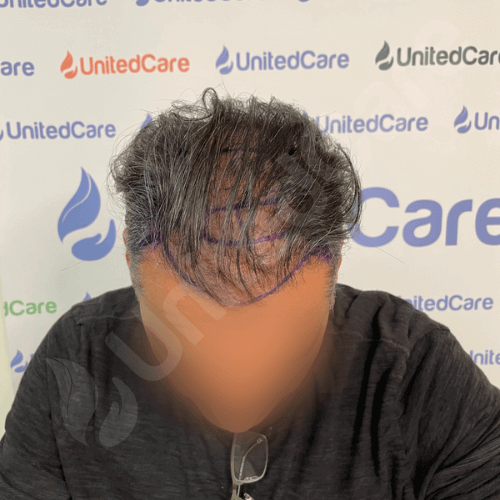
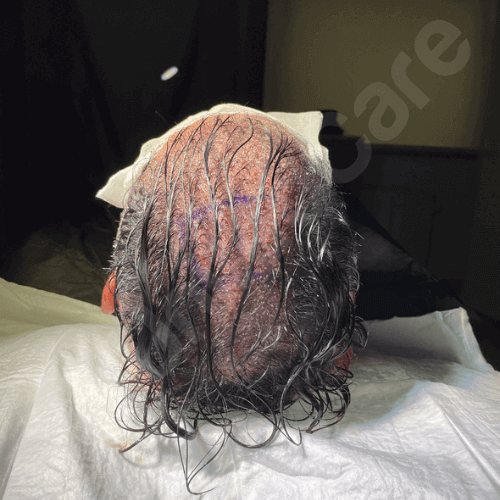
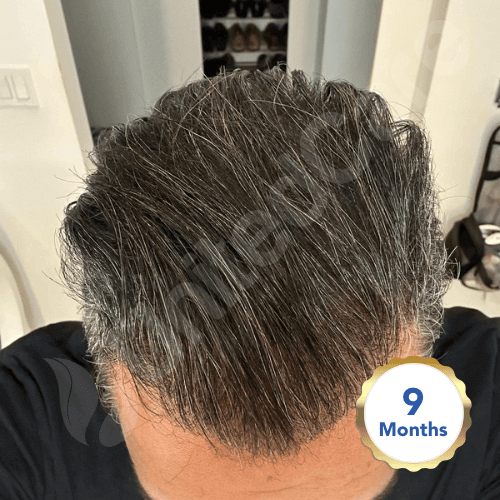
Reasons I preferred DHI hair transplant in this case:
- There are hairs in the hair transplantation zone/recipient zone which should be protected.
- Bald zones are not that big.
- 3470 grafts were enough for coverage.
- The patient’s budget allowed for a slightly higher cost.
DHI vs FUE Comparison Case 2; where FUE wins:
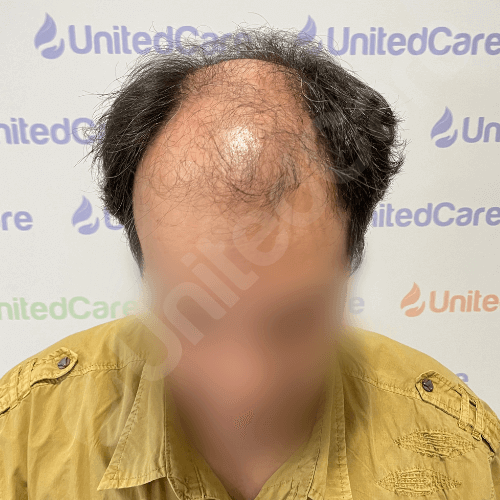
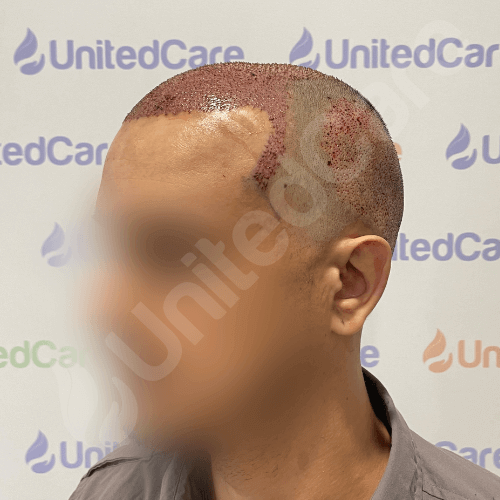
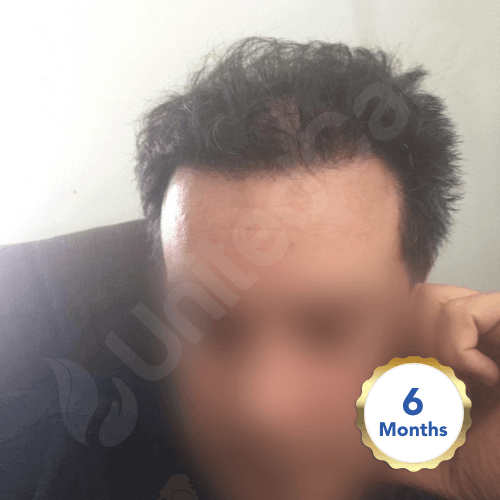
Reasons I preferred FUE hair transplant in this case:
- Balding/recipient zones are very big.
- Mega session around 4800 grafts were done.
- The budget was limited.
Once had thick and strong hair?
Let’s restore it with DHI or FUE technique.
❝ Perfect experience and results, can only recommend going there. I’d pay much more than they charged for all the quality of life improvement I got from having my hair back. ❞

References
- Kayiran O, Cihandide E. Evolution of hair transplantation. Plast Aesthet Res. 2018;5:9. http://dx.doi.org/10.20517/2347-9264.2017.86